 Appointment Lookup
 213-596-2538
LG washer not draining? Learn the top causes—clogged drain pump filter, kinked hose, bad pump—and when to call a pro for fast repair.
Your washer may not be working due to a power issue, an unlatched lid or door, a clogged drain hose, an unbalanced load, or a failed component like the lid switch, drive belt, motor, or control board. Start by checking power, the door latch, and the water supply valves before moving on to internal parts. Most no-start and no-spin problems trace back to one of a handful of causes, and about a third of them are things a homeowner can fix in ten minutes without tools. The rest usually need a technician.
KEY TAKEAWAYS
Washers fail in predictable ways. After enough service calls, the same six culprits show up over and over — and knowing which category you're in tells you whether to grab a flashlight or a phone.
No lights, no sounds, nothing. That's almost always a power problem — a loose cord, tripped breaker, or dead outlet. Front-loaders on GFCI circuits are especially prone to nuisance trips.
Modern washers won't run with the door or lid unlatched. A worn strike, a bent latch, or a failed lid switch tells the control board the door is open even when it's closed shut.
If the washer starts but won't fill, the supply valves behind the machine may be closed, the hoses kinked, or the inlet screens clogged with sediment. A failed inlet valve solenoid produces the same symptom.
A sock, coin, or hair-mat lodged in the drain hose or pump filter will stop drain and spin cycles cold. You'll usually see standing water in the drum.
High-efficiency washers refuse to spin when the load shifts to one side. If the machine itself isn't level, it'll shake, walk across the floor, and abort the cycle.
Drive belts, motor couplings, control boards, and drum bearings all wear out. These are the failures that push a washer into professional-repair territory — see how we diagnose a washer that isn't working for the specifics.
A washer that shows no signs of life is almost always an electrical or latch issue. Work through these in order.
Confirm the plug is fully seated. Vibration walks plugs loose over time. Test the outlet with a lamp or phone charger to rule out a dead receptacle.
Find the breaker panel and look for a switch stuck between on and off. Flip it fully off, then back on. If the washer is on a GFCI, press the reset button on the outlet itself.
Open and firmly close the lid or door. Listen for the click of the lock engaging. On top-loaders, the lid switch is a small plunger under the lid — if it's broken off, the washer thinks the lid is up.
Most washers built after 2015 flash a fault code (like F21, LE, or E1) instead of dying silently. Write it down before you reset the machine — that code tells a technician exactly which subsystem failed.
⚠️ Warning: Never bypass a lid switch or door lock to force a cycle. The interlock exists to keep hands out of a spinning drum turning at 1,200+ RPM.
If the cycle starts but no water enters the drum, the problem is upstream.
Pull the washer forward and confirm both hot and cold valves are fully open. A half-closed valve produces a slow fill or a fill-related error code.
Rubber hoses collapse from the inside as they age. Look for sharp bends behind the machine, and squeeze the hoses — they should feel firm, not spongy.
Turn off both water valves, unscrew the hoses from the back of the washer, and pull out the small mesh screens with needle-nose pliers. Rinse them under a faucet. Sediment buildup here is one of the top three fill failures we see.
If supply and screens are clear but the washer still won't fill, the electric inlet valve solenoid is likely burned out. Replacement runs $150-$300 typical including labor. This is a manufacturer-trained technician job because it involves water lines and 120V wiring in close quarters.
Spin and drain problems tend to share root causes. If the pump can't clear the water, the machine won't spin.
Front-loaders have an access panel at the lower front — behind it is a pump filter that catches coins, hairpins, and lint. Place a shallow pan underneath, unscrew the filter, and clear the debris. Do this every six months. For a deeper walkthrough, see our washer won't spin troubleshooting guide.
If you hear the motor humming but the drum doesn't move, the belt or direct-drive coupling has failed. Coupling replacement on a Whirlpool direct-drive top-loader is a common repair.
A loud grinding or roaring during spin — like a jet engine — is drum bearings. Bearing replacement is labor-intensive; on older machines, it's often the point where replacement becomes the smarter call.
A washer with a bad lid switch will fill and agitate but refuse to spin. The safety logic assumes the lid is up.
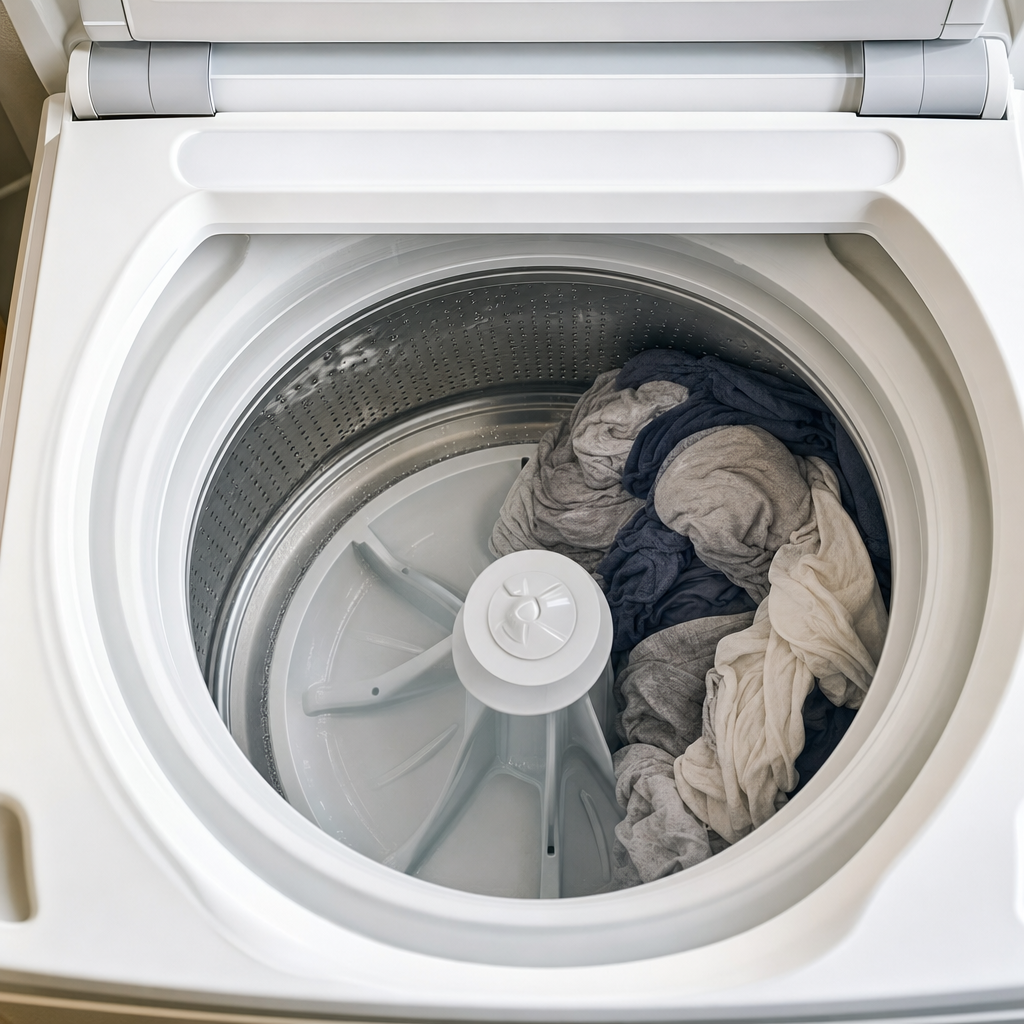
Before you book service, run through this checklist. Roughly a third of the service calls we take could have been solved in the laundry room.
Open the washer, pull the wet laundry apart, and redistribute it evenly around the drum. Then check that the machine sits flat — a bubble level on top of the washer should read center. Adjust the front feet if it rocks.
Unplug the washer for one to five minutes, then plug it back in. This clears the control board's memory and resolves a surprising number of phantom faults. On many models, press and hold Start/Pause for 3-5 seconds after power returns.
On front-loaders, the pump filter behind the kick-plate is the #1 DIY win. On top-loaders, the pump is internal but you can still fish debris out of the drain hose where it enters the standpipe.
Reach under the rubber door boot on front-loaders. Bras with underwires, coins, and small socks migrate there and jam the drum.
| Situation | Typical Cost | Best Choice |
|---|---|---|
| Washer under 8 years, single component failure | $150-$400 typical | Repair |
| Washer 8-12 years, major failure (bearings, transmission) | $500-$800 typical | Case-by-case |
| Washer 12+ years, major failure | $600+ typical | Replace |
| Cosmetic or minor part | $150-$300 typical | Repair |
For a full breakdown, our guide on whether it's worth repairing a washer walks through the math.
Some repairs are safe DIY. Others aren't. Here's the line.
Grinding noises, burning smells, water leaking from underneath, sparks, or repeated tripped breakers all mean stop and call. So does any error code that persists after a power-cycle reset.
Control boards, motor windings, wiring harnesses, and any component behind the back panel involve 120V circuits and, on some models, ground-fault protection that's easy to defeat by accident. Leave those to a manufacturer-trained technician.
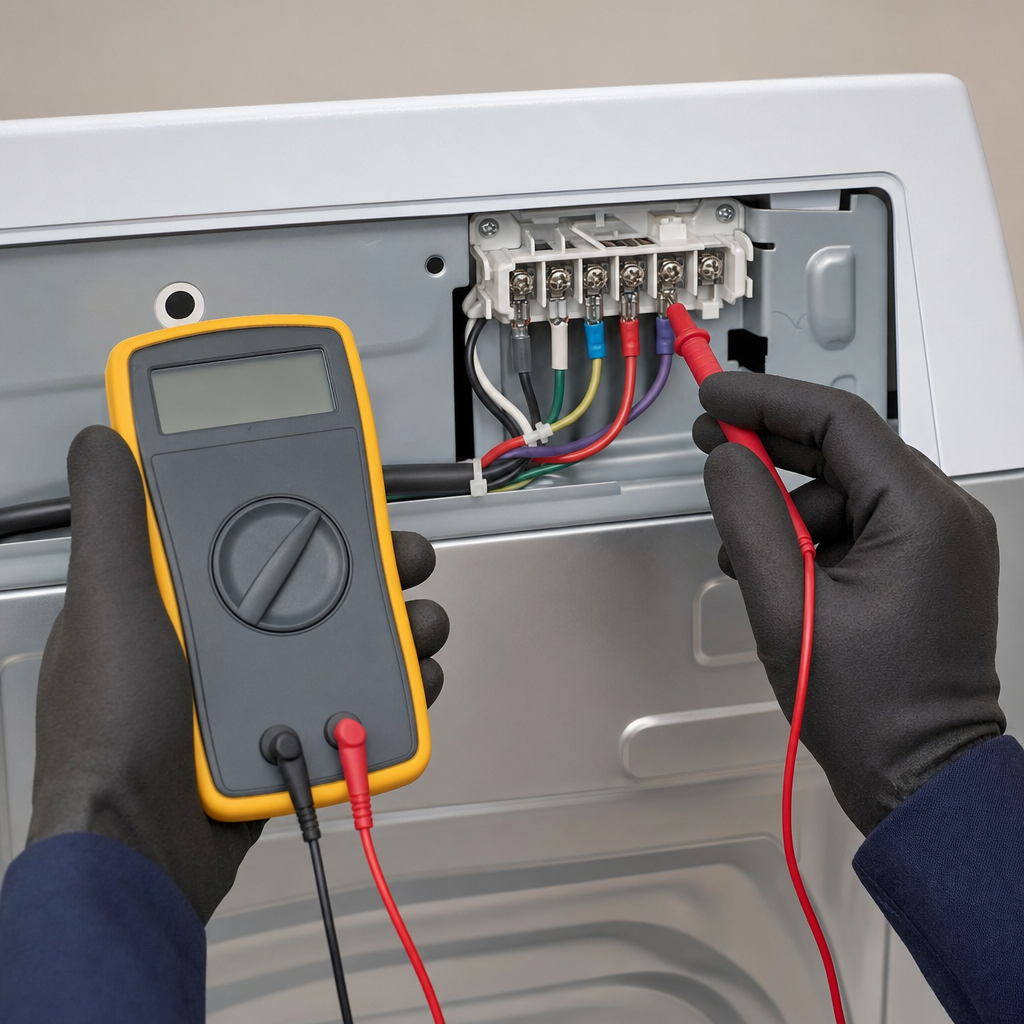
When you book washer repair services with SHS, a manufacturer-trained technician arrives in a marked truck stocked with commonly needed parts. They diagnose the problem, then provide an exact quote — parts and labor — before any work begins. You approve the cost up front. If you decline, you pay only the diagnostic fee, which runs $90 to $150 depending on the appliance and is waived if you proceed with the repair.
Every repair is backed by a service guarantee. The quote doesn't change once provided — no surprise add-ons. For ongoing coverage across your major appliances, a Sears Protect plan covers most brands regardless of age. Common repair questions are answered in our repair FAQ, and our appliance repair blog has model-specific guides.
With years of experience, our technicians possess the skills to repair your washer, regardless of the issue.
Loading scheduler options...
LG washer not draining? Learn the top causes—clogged drain pump filter, kinked hose, bad pump—and when to call a pro for fast repair.
Learn how to repair a Kenmore washer with step-by-step fixes for common issues like leaks, no spin, and error codes. DIY tips plus when to call a pro.

Learn how a hall sensor works in a washer to control spin basket speed and direction.

Learn how a pressure transducer works to detect water level in a washing machine.
The drum is the core part of the washer that holds your laundry and enables the cleaning process through rotation, agitation, and rinsing.
Hard water is water that contains high levels of dissolved minerals, particularly calcium and magnesium. It contrasts with soft water, which has lower concentrations of these minerals.
A washing machine pedestal is a platform that raises the washer off the ground, providing easier access to the appliances and often includes additional storage space such as drawers.
A washer tub is the interior part of a washing machine where clothes are placed for washing, typically made of stainless steel, plastic, or porcelain-coated metal, designed to hold water and withstand the agitation or spinning during the wash cycle.
The most common reasons your LG washer is leaking from bottom are a clogged water valve assembly, broken motor or a cracked drain hose.
The most common reasons your GE washer won't start cycle are a malfunctioning electronic control board, jammed door lock assembly or a faulty user interface.
The most common reasons your Whirlpool washer is not rinsing are a faulty lid switch, a bad water-level pressure switch, or a defective timer.
The most common reasons your GE washer is not filling are a clogged water valve assembly, malfunctioning electronic control board or a bad water level pressure switch.
The most common reasons your Samsung washer top load is not filling with water are a clogged water valve, a malfunctioning PCB, or a cracked hose.
The most common reasons your Samsung washer is noisy are a damaged suspension rod, malfunctioning electronic control board or a broken motor.