 Appointment Lookup
 213-596-2538

Discover the top 11 reasons why your refrigerator is not cooling. Get expert tips and solutions from Sears Home Services.
What Is a Freezer Compressor and What Does It Do?
How Does a Freezer Compressor Work?
What Are the Signs of a Failing Freezer Compressor?
What Causes Freezer Compressors to Fail?
Can You Repair or Replace a Freezer Compressor Yourself?
How Much Does Freezer Compressor Repair or Replacement Cost?
How Sears Home Services Fixes Freezer Compressor Problems
Frequently Asked Questions
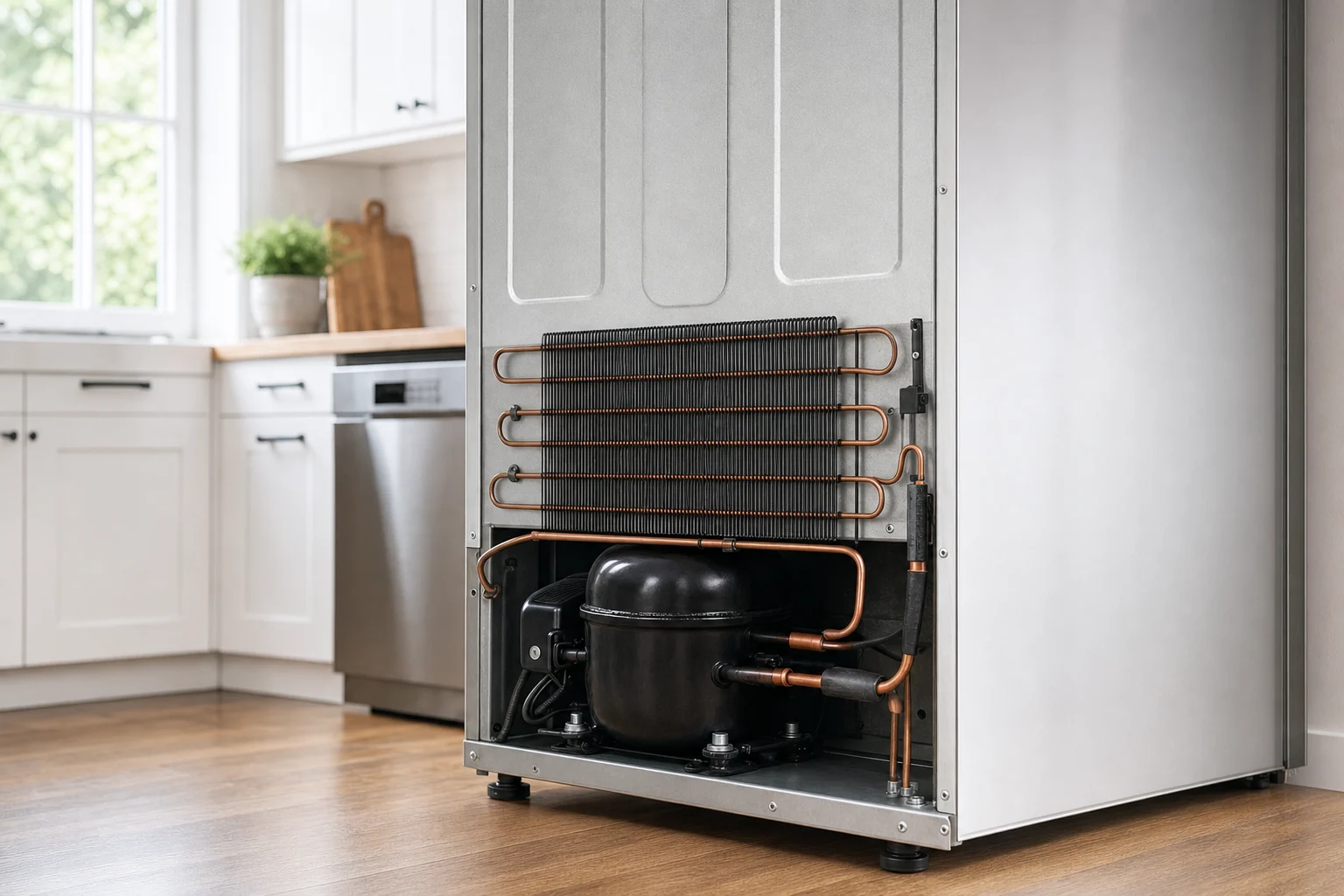
A freezer compressor is the motor-driven pump at the heart of your freezer's cooling system that compresses refrigerant gas and circulates it through the coils to remove heat from the interior. Without a working compressor, the freezer cannot maintain freezing temperatures. If your freezer is humming loudly, running constantly, or letting food thaw, the compressor or one of its supporting parts is often the reason. This guide breaks down what the compressor does, how to spot failure early, what repair typically costs, and when it's time to call a manufacturer-trained technician.
KEY TAKEAWAYS
Think of the compressor as the heart of your freezer. It's a sealed, motor-driven pump that pressurizes refrigerant gas and pushes it through a closed loop of coils. That pressure change is what makes the refrigerant able to absorb heat from inside the freezer and dump it outside — the entire reason your freezer gets cold.
Refrigerant does the cooling, but the compressor makes the refrigerant work. It raises the gas to a high pressure and temperature so it can release heat at the condenser coils. Without that pressure boost, the refrigerant just sits there and nothing freezes.
On most upright and chest freezers, the compressor is a black, football-sized cylinder mounted at the back or bottom rear of the cabinet. Pull the unit away from the wall and you'll see it bolted to a metal base with copper lines running in and out.
The compressor drives a three-stage refrigeration cycle that repeats continuously whenever cooling is needed.
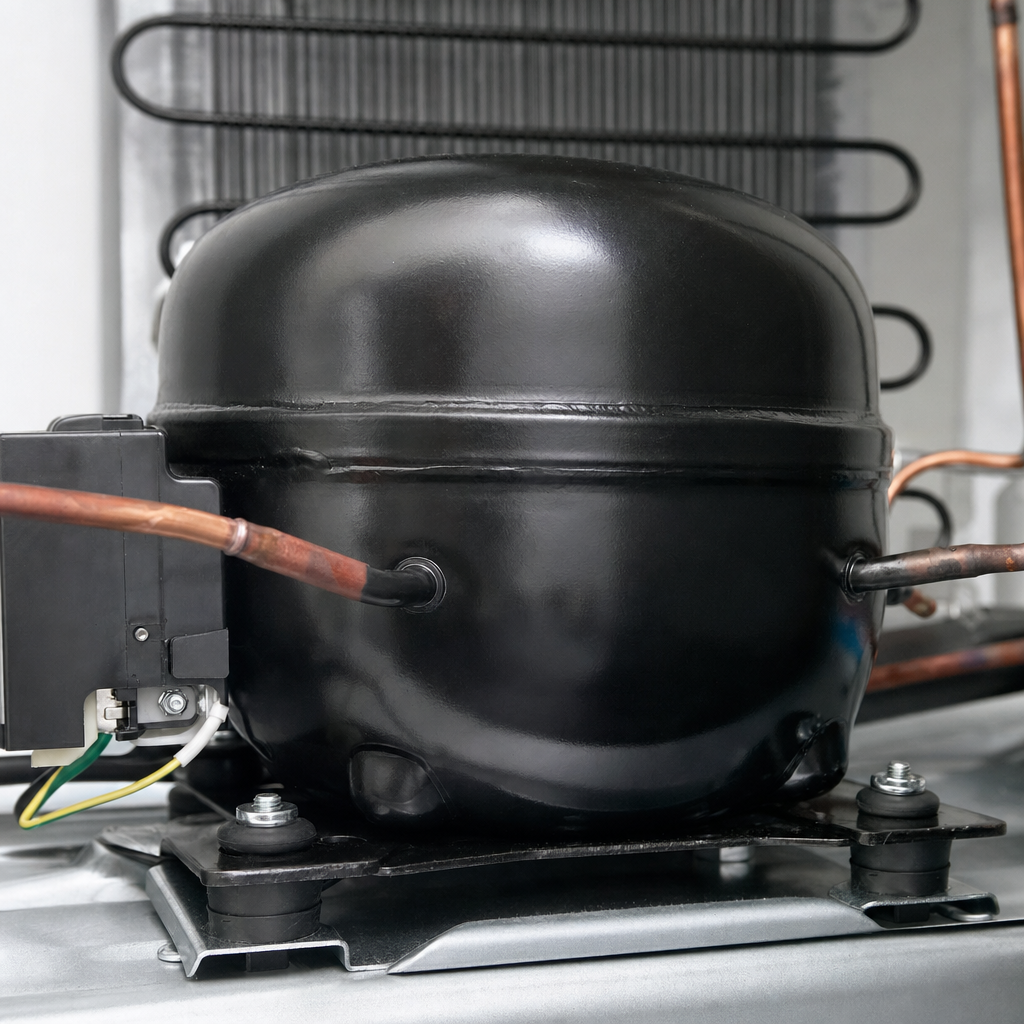
Low-pressure refrigerant vapor enters the compressor from the evaporator. The compressor squeezes it into a high-pressure, high-temperature gas and pushes it out toward the condenser coils.
The hot pressurized gas travels through the condenser coils, usually on the back or underneath. Air flowing across the coils carries heat away, and the refrigerant condenses into a warm liquid. This is why the back of your freezer feels warm during normal operation.
The liquid refrigerant passes through a narrow metering device (a capillary tube or expansion valve), where its pressure drops sharply. That pressure drop makes it evaporate inside the evaporator coils, absorbing heat from the freezer compartment. The now-cold vapor returns to the compressor, and the cycle repeats.
For a deeper look at why compressors run hot during this process, see why your refrigerator compressor gets hot.
Compressors rarely fail without warning. Here's what to watch for.
The clearest sign is a freezer that runs but doesn't freeze. If the motor is humming but interior temperatures climb above 0°F, the compressor may be losing its ability to pressurize refrigerant — or a supporting component like the start relay has failed. This is a similar failure pattern to when a refrigerator's freezer works but the fridge section doesn't.
A healthy compressor is quiet. Loud humming, repeated clicking every few minutes, or a buzzing that wasn't there before usually points to a struggling motor, a failing start relay, or the overload protector cycling on and off. If you're hearing new freezer noises you can't explain, don't ignore them.
Some warmth is normal. Painfully hot is not. A compressor that runs nonstop and can't be touched for more than a second is overheating, often because of dirty coils, a refrigerant issue, or internal wear.
If the interior light works but the compressor is silent and the freezer is warming, the compressor motor or its start components have likely failed outright.
Dust and pet hair on the condenser coils act like a blanket, trapping heat. The compressor works harder, runs hotter, and wears out years earlier than it should. This is the single most preventable cause of failure.
Most "dead compressor" calls turn out to be a bad start relay or capacitor — small parts that tell the compressor motor to kick on. These are far cheaper to replace than the compressor itself, which is why diagnosis matters.
A slow leak in the sealed refrigerant loop starves the compressor. Without enough refrigerant to move, it runs constantly, overheats, and eventually burns out.
Compressors are mechanical. Bearings wear, valves lose their seal, and windings degrade. Most units give 10 to 15 years of service, sometimes more with good maintenance.
Short answer: no. Longer answer: there are still useful things you can do before calling a pro.
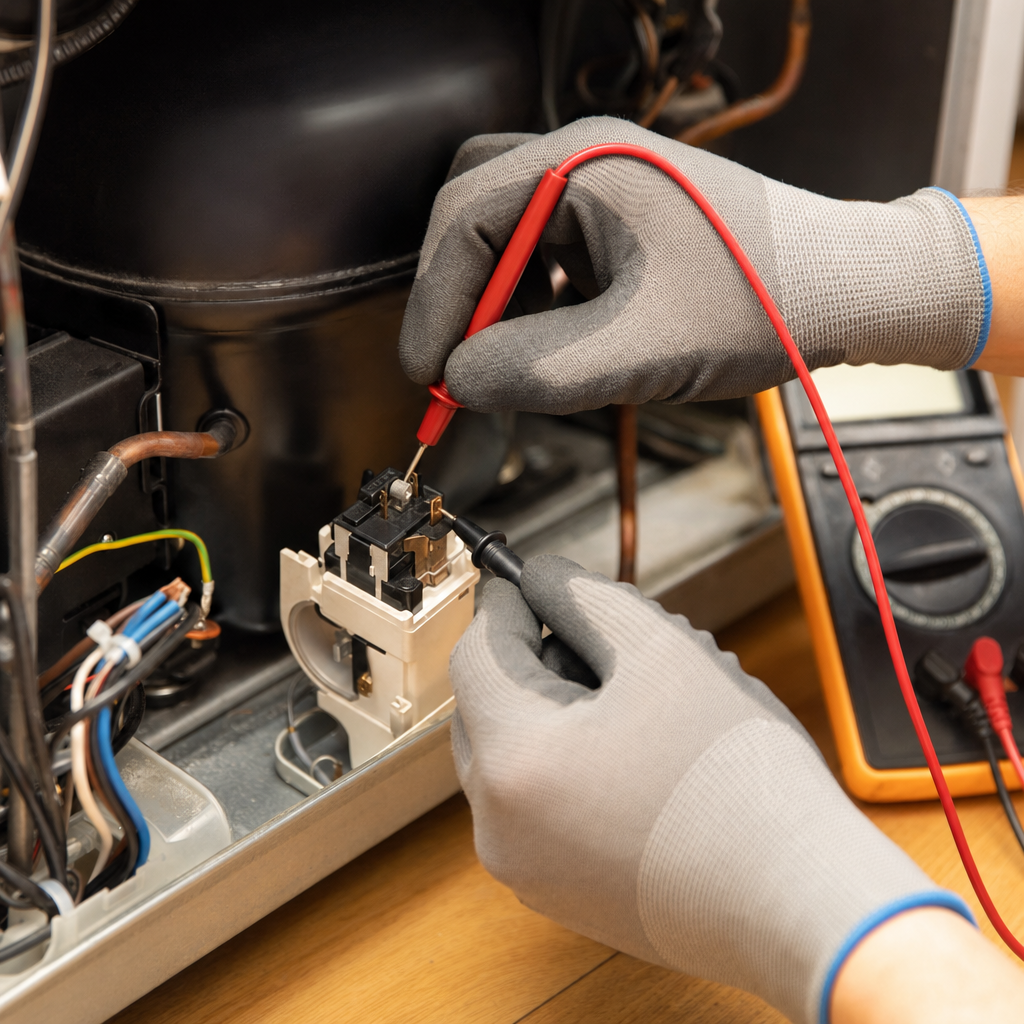
Replacing a compressor means opening the sealed refrigeration system, recovering the old refrigerant, brazing new copper joints, pulling a vacuum, and recharging with the correct refrigerant to the exact factory spec. Under EPA Section 608 rules (epa.gov), only EPA-certified professionals can handle refrigerant. Doing it wrong vents refrigerant to the atmosphere, voids any warranty, and usually kills the new compressor within weeks.
Before you call anyone, try this:
If the freezer still won't cool after those checks, stop. Anything involving refrigerant lines, sealed-system parts, or opening the compressor housing is a job for a manufacturer-trained tech. Book professional freezer and refrigerator repair at that point.
| Repair | Typical range (parts + labor) |
|---|---|
| Start relay or capacitor replacement | $150-$350 |
| Condenser fan motor | $200-$450 |
| Refrigerant recharge (with leak repair) | $300-$700 |
| Full compressor replacement | $500-$1,200+ |
Actual pricing varies by brand, model, and whether the compressor is a standard reciprocating unit or an inverter/linear type.
The rule of thumb: if the freezer is more than 10 years old and the repair quote is over half the cost of a comparable new unit, replacement usually wins. Newer freezers are also significantly more efficient (see ENERGY STAR for current ratings), which offsets some of the upfront cost. If you're seeing multiple signs your refrigerator or freezer is dying, lean toward replacement.
Sears Home Services charges a diagnostic fee of $90 to $150 depending on the appliance, waived if you proceed with the repair. Your technician provides an exact quote — parts and labor — that doesn't change once provided. You approve the cost before any work begins. If you decline, you pay only the diagnostic fee. For ongoing coverage across your appliances, a home service plan can offset future repair costs.
Sears Home Services is the #1 appliance repair service in the country, with 1,500+ manufacturer-trained technicians with an average of 10+ years of experience. Our techs test the start relay, capacitor, overload protector, and compressor windings before recommending sealed-system work — because those small parts fail far more often than the compressor itself.
We repair most major brands, no matter where you bought it: Whirlpool, Maytag, Samsung, LG, GE, Kenmore, KitchenAid, Frigidaire, Amana, Bosch, JennAir, Hotpoint, Haier, Fisher & Paykel, and more.
Book online or by phone. Available 6 days a week, with early morning to evening appointments. Check for same-day availability in your area. You'll get confirmation by email and text, reminders the day before, and real-time technician tracking on service day. All repairs come with a service guarantee. Sears Protect members receive additional benefits and perks — save when you enroll in Sears Protect today.
Backed by years of experience, our technicians possess the skills necessary to fix your refrigerator. And because our techs our local, they can fix it for you fast.
Loading scheduler options...
Discover the top 11 reasons why your refrigerator is not cooling. Get expert tips and solutions from Sears Home Services.

Discover the most common problems with Samsung refrigerators, including cooling issues, total cooling failure, and ice maker malfunctions. Learn how to troubleshoot these issues and find reliable repair solutions with Sears Home Services.
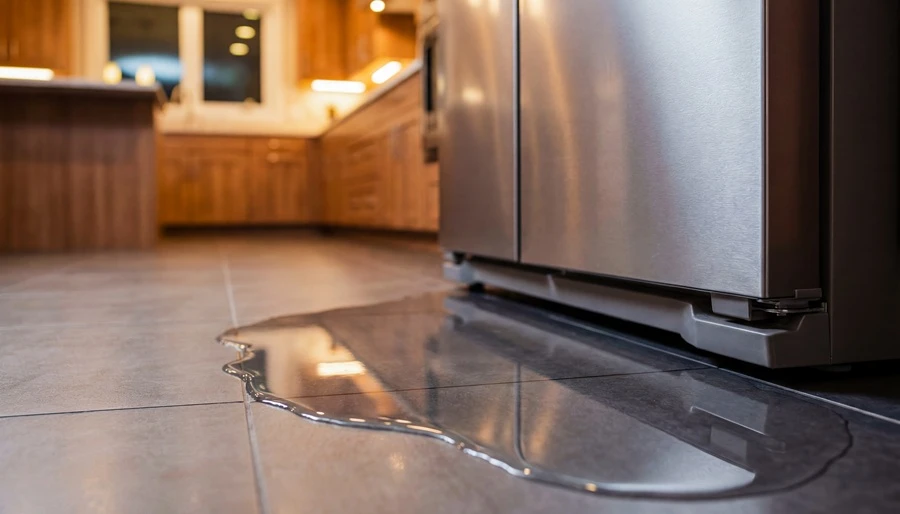
A leaking refrigerator is more than a household inconvenience—it can pose serious safety and health risks. This guide explains why refrigerators leak, the dangers involved, and the essential steps homeowners should take to protect their home, family, and appliance.

When your refrigerator starts making strange noises, distinguishing between normal sounds and potential problems becomes essential.
A compressor is a mechanical device that increases the pressure of a gas by reducing its volume, essential in various systems including refrigerators, air conditioners, and HVAC units for cooling and refrigeration processes.
A condenser is a component of HVAC and refrigeration systems, responsible for releasing absorbed heat from the refrigerant into the outside air or a water line, thus facilitating the cooling process.
A dual ice maker is a feature in some refrigerators that includes two separate ice makers: one in the fridge compartment and another in the freezer section. This setup doubles the appliance's ice-making capacity.
A French-door refrigerator features two doors that open side-by-side on the top section for the refrigerator compartment, with a bottom freezer drawer, combining style, efficiency, and easy access to both refrigerated and frozen goods.
The most common reasons your LG refrigerator icemaker reset button is not working are a faulty icemaker, a malfunctioning PCB, or a defective water valve.
The most common reasons your Samsung refrigerator is leaking water are a clogged defrost drain, cracked dispenser water tubing or a damaged evaporator.
The most common reasons your Kenmore Elite refrigerator stopped working are a locked compressor, damaged evaporator or a defective electronic control board.
The most common reasons your Maytag refrigerator stopped working are a locked compressor, damaged evaporator or a defective electronic control board.
The most common reasons your Kenmore refrigerator is noisy are a faulty ice maker assembly, defective electronic control board or a locked compressor.
The most common reasons your Kenmore refrigerator fan is not working are a defective electronic control board, damaged evaporator or a locked compressor.