 Appointment Lookup
 213-596-2538

Learn how a pressure regulator works on a gas range.

Gas stoves have been a kitchen staple for decades, prized for their precision, instant heat, and reliability. But how exactly do they work to transform a simple flame into a culinary powerhouse?
Understanding the mechanics of a gas stove not only enhances your appreciation for this kitchen appliance but can also guide you in its proper use and maintenance. Let’s take a detailed look at how gas stoves work.
KEY TAKEAWAYS
A gas stove is a cooking appliance that uses natural gas or propane as its fuel source. When ignited, the gas produces a flame that heats cookware directly. This direct heat offers unmatched control, allowing you to make quick adjustments to temperature, which is why gas stoves are often preferred in many kitchens.
A gas stove connects to your home’s gas supply through a gas line with a shut-off valve. The incoming gas supply then connects to a pressure regulator that limits gas pressure and flow to design specifications for your stove.
From the pressure regulator, the gas supply branches out to the cooktop burners and the oven burners. Here are descriptions of those stove systems.
Here’s how the cooktop burner system works in a gas stove:
The oven and cooktop of a gas stove offer significant advantages over electric ranges.
Follow these expert tips to use your gas stove safely.
Gas stoves release combustion byproducts, so make sure your kitchen is well-ventilated. Run the range hood when using the gas stove.
Keep the range hood running for a few minutes after you finish cooking or baking to exhaust all combustion fumes out of your kitchen.
Clogged burner nozzles can cause combustion problems and affect flame performance. Follow the procedure shown in this popular YouTube video to thoroughly clean stove top burners:
Always double-check that burners are completely off after cooking.
Periodically inspect your gas supply line and connections.
Use soapy water to detect leaks—bubbles will form where gas escapes from leaks or loose gas line connections.
If you ever smell gas, turn off the stove immediately, ventilate the area, and contact your local gas company.
Overcrowding the oven can block heat circulation, leading to air circulation problems in the oven cavity and uneven cooking.
Follow the tips in this helpful YouTube video to position and use oven racks properly:
Schedule professional oven maintenance every year. A qualified service technician will visit your home and perform these essential oven maintenance, inspection and cleaning tasks:
Annual professional maintenance won’t just ensure that the stove works safely and efficiently, it will also help your appliance last longer.
Follow these expert troubleshooting tips when you encounter problems with your gas stove’s oven.
Several different problems can prevent the oven in your gas stove from heating. Follow the tips in this popular YouTube DIY video to fix an oven heating problem in your gas stove:
If you’re unable to find and fix the oven heating problem yourself, schedule range repair service and we’ll send a Sears Home Services technician to your home to resolve the issue.
If the oven isn't heating to the baking temperature you set — it's too hot or not hot enough — the oven temperature sensor could be malfunctioning. Or the problem could be with the electronic oven control board, which controls oven functions.
You can test the oven temperature sensor probe by unplugging the range and measuring sensor probe resistance using a multimeter. It should measure about 1,080 ohms of resistance through most probes at room temperature.
Refer to the tech sheet for the probe's resistance specification for your range. You can likely find the tech sheet in the control console or taped to the back of the range. Replace the oven temperature sensor probe if the multimeter doesn't measure the correct resistance through the probe. If the probe is okay, you might need to replace the electronic oven control board.
If you’re unable to find and fix the cause of this problem on your own, schedule stove repair service and we’ll fix the issue for you.
Gas stoves continue to be a favorite among home cooks. Their straightforward yet effective design combines practicality with precise performance, making them indispensable in kitchens across the country.
Whether you’re simmering a delicate sauce or searing a steak, understanding how your gas stove works empowers you to make the most of this versatile appliance. Plus, with proper care and maintenance, your gas stove will serve you reliably for years to come.
Sears Home Services is standing by to help you with gas stove maintenance and repairs any time you need them. Trust us to handle all of your home appliance needs.
Our technicians have the experience to tackle any range issue. Count on us to get you cooking again in no time.
Loading scheduler options...
Learn how a pressure regulator works on a gas range.
Learn how an electric range works and how to troubleshoot common problems.
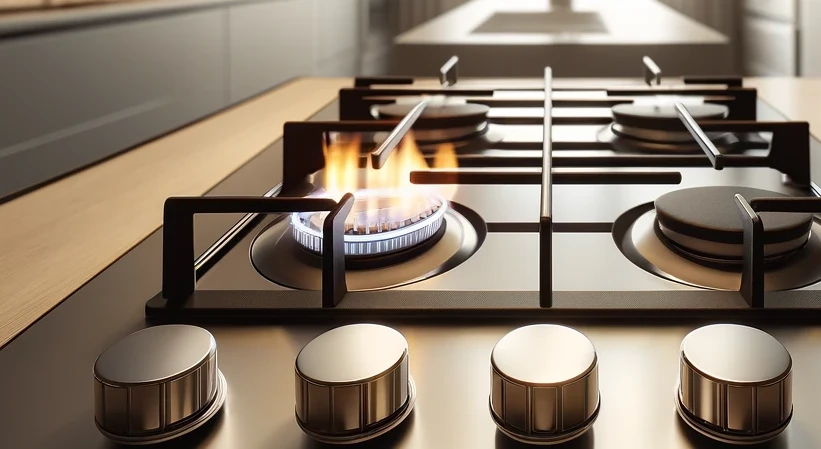
Discover 7 reasons why your cooktop burner flame is too high. Get expert tips on how to adjust the flame on a gas stove from Sears Home Services.

Find out why your gas stove is clicking and how to fix the problem.
A convection range is a kitchen appliance that features a convection oven, which uses a fan and exhaust system to circulate hot air around the food, resulting in faster, more even cooking and baking compared to conventional ovens.
A drop-in range is a type of kitchen stove that is designed to be fitted into a pre-existing space in kitchen cabinetry, mounted on a platform, flanked by cabinetry, and often featuring a custom panel at the bottom.
A dual fuel range combines the precision of an electric oven with the responsiveness of a gas cooktop, offering the best of both worlds for cooking enthusiasts.
BTU, or British Thermal Unit, measures the amount of heat required to raise the temperature of one pound of water by one degree Fahrenheit.
The most common reasons your Frigidaire range is not heating are a faulty igniter, inoperative electronic control board or a broken bake element.
The most common reasons your Whirlpool range burner is not working are a bad switch, faulty igniter or a cracked ceramic glass top.
The most common reasons your Jenn-Air range display is not working are an inoperative electronic control board, inopertive control panel or a dead power supply board.
The most common reasons your GE cooktop burner is not working are a cracked igniter switch, broken igniter or a cracked main top.
The most common reasons your Frigidaire range burner is not working are a bad switch, faulty igniter or a cracked ceramic glass top.
The most common reasons your KitchenAid range is not working are an inoperative electronic control board, faulty igniter or a bad switch.