 Appointment Lookup
 419-558-4893

Learn about home warranties and how they work to safeguard your home. Trust Sears Home Services for reliable protection.

In the middle of a real estate transaction, one question often creates confusion for both buyers and sellers: Who pays for a home warranty? With multiple parties involved, including the home warranty company, agents, and lenders, understanding payment responsibility is not always simple.
A home warranty offers coverage for critical home systems and appliances, providing valuable financial protection in case of breakdowns. But knowing whether the seller’s home warranty is included in the deal or if the buyer needs to purchase coverage separately can make or break negotiations.
This article explores every angle of home warranty payments—covering scenarios where the seller pays home warranty, situations where buyers invest in protection, and how agents handle warranties during closing. You’ll also learn about costs, payment methods, and special cases so you can make informed decisions.
KEY TAKEAWAYS
The short answer: it depends.
In many real estate deals, a home warranty is considered a negotiable item, just like seller concessions, repair credits, or other closing costs. Here are the most common scenarios:
Quick Tip: Ask your real estate agent to confirm how warranties are typically handled in your local market. The agent can also help you understand how a home warranty works.
The seller pays home warranty plan costs in many real estate transactions, and for good reason.
Sellers typically arrange warranties through a home warranty provider during listing preparation. Their real estate agent ensures it is noted in the contract and rolled into the closing costs for a seamless process.
Not every transaction includes seller-paid coverage. Buyers often choose to purchase their own home warranty coverage, either during or after closing. In a seller’s market, extra perks such as a home warranty often won’t be offered by the seller.
For more details, see what do home warranties cover to understand what’s included.
Also, here’s a brief video that gives you a clear idea of what our Sears Protect Plan covers:
A real estate transaction often comes down to negotiation—and warranties are no exception.
Buyers may request a warranty in their offer, especially for older homes. Sellers may offer it proactively to secure stronger offers.
The real estate agent often facilitates communication with the warranty provider and ensures the service contract is attached to the purchase agreement.
Warranties are usually added to the buyer’s real estate closing costs, which are settled at closing. Coverage typically activates the day ownership transfers.
Every detail—such as who pays, what plan is chosen, and when coverage begins—should be spelled out in writing to avoid disputes.
While costs vary, here’s what you can expect:
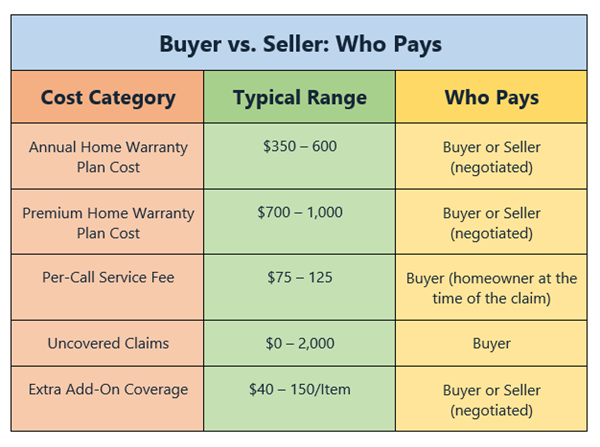
Not every transaction fits neatly into buyer-paid or seller-paid categories.
For many, home warranties are worth it because they provide financial protection against repair surprises—coverage that complements, but does not replace, homeowner’s insurance.
The question of who pays for home warranty doesn’t have a one-size-fits-all answer. Sometimes the seller’s home warranty is included in closing costs, other times the buyer opts in, and often it’s a negotiable part of the real estate transaction.
What matters most is ensuring the warranty is documented in writing and that both parties understand what’s covered. Whether you’re a buyer looking for peace of mind, a seller hoping to close faster, or an agent navigating negotiations, a home warranty can add value and security.
Learn about home warranties and how they work to safeguard your home. Trust Sears Home Services for reliable protection.

What does a home warranty cover? Find out now.

This guide explains what home warranties typically cover, from major systems like HVAC and plumbing to appliances like refrigerators and washers. It also highlights common exclusions and how coverage works so you can choose the right plan with confidence.

Discover the top advantage of having a home warranty with Sears Home Services.
The 608 Certification, mandated by the Environmental Protection Agency (EPA), is required for HVAC technicians to legally handle refrigerants. It ensures technicians understand refrigerant types, environmental impact, and proper handling techniques.
A compressor is a mechanical device that increases the pressure of a gas by reducing its volume, essential in various systems including refrigerators, air conditioners, and HVAC units for cooling and refrigeration processes.
A condenser is a component of HVAC and refrigeration systems, responsible for releasing absorbed heat from the refrigerant into the outside air or a water line, thus facilitating the cooling process.
A capacitor in an AC unit is an electrical component that stores and releases electrical energy to help start the motor and stabilize the voltage during operation.
When your Payne central air conditioner won’t turn on or isn’t cooling, check for power problems, a failed capacitor, or a clogged condensate drain. This guide covers quick, safe troubleshooting steps and explains when to call Sears Home Services for expert central AC repair.
When your ICP central air conditioner won’t turn on or isn’t cooling, check for power problems, a failed capacitor, or a clogged condensate drain. This guide covers quick, safe troubleshooting steps and explains when to call Sears Home Services for expert central AC repair.
When your Heil central air conditioner won’t turn on or isn’t cooling, check for power problems, a failed capacitor, or a clogged condensate drain. This guide covers quick, safe troubleshooting steps and explains when to call Sears Home Services for expert central AC repair.
When your Carrier central air conditioner won’t turn on or isn’t cooling, check for power problems, a failed capacitor, or a clogged condensate drain. This guide covers quick, safe troubleshooting steps and explains when to call Sears Home Services for expert central AC repair.
When your Comfortmaker central air conditioner won’t turn on or isn’t cooling, check for power problems, a failed capacitor, or a clogged condensate drain. This guide covers quick, safe troubleshooting steps and explains when to call Sears Home Services for expert central AC repair.
When your Ruud central air conditioner won’t turn on or isn’t cooling, check for power problems, a failed capacitor, or a clogged condensate drain. This guide covers quick, safe troubleshooting steps and explains when to call Sears Home Services for expert central AC repair.