 Appointment Lookup
 802-613-1926

Discover what the Seasonal Energy Efficiency Ratio (SEER) is and why it's crucial for assessing air conditioner efficiency.
The most common reasons for your Carrier central air conditioner blowing warm air are a dirty air filter, thermostat problems, or a bad capacitor.
32% of the time it's the Dirty Air Filter
26% of the time it's the Thermostat Problem
24% of the time it's the Bad Capacitor
18% of the time it's the Something else
We can help! Our certified technicians repair all models of Carrier central air conditioners. We can fix yours no matter where you bought it.
Loading scheduler options...
When your Carrier air conditioner is blowing warm air, the problem is often something simple. A dirty air filter, a thermostat issue, or a failed capacitor can shut down the unit’s cooling. Here’s how each issue causes your central AC to blow warm air and what you can safely check yourself before calling a technician.
A clogged air filter restricts airflow, causing the evaporator coil to freeze and the system to lose cooling capacity. Sometimes the AC will run constantly but blow warm air.
If the old filter was heavily clogged, it may take a few hours for the evaporator coil to thaw and cooling to return. If cooling doesn’t resume, you may need to schedule HVAC repair service.
Incorrect settings, low batteries, or wiring issues can cause the AC system to blow warm air.
If the thermostat doesn’t respond after fresh batteries and proper settings, the internal electronics or wiring may be failing. Schedule AC repair service.
Your AC has capacitors that help the compressor and condenser fan motor start. When a capacitor fails, the outdoor unit may hum but not start, or it may start and shut off quickly.
Capacitors store electricity even when the power is off. Do not open the outdoor unit or touch the capacitor.
However, you can do one safe check:
If the fan still won’t run or the unit only hums, a technician likely needs to replace the capacitor.
Most Carrier central AC systems have a safety float switch that shuts off cooling when the condensate drain line backs up. This prevents water damage but also stops the AC from running or cooling.
When you see water dripping below the inside unit and no water coming through the AC condensate drain hose outside you house, the drain line is likely clogged.
If you have a wet/dry shop vac, you can try vacuuming the drain line outside at the termination point. You may need to use a plumber’s snake to clear the drain line if it’s severely clogged.
View this troubleshooting video for more tips on clearing a clogged AC drain line and keeping it clear:
If the drain pan below the evaporator keeps filling and won’t drain, professional HVAC service is needed.
If the system has no or low refrigerant because of a leak in the sealed system, the evaporator coil can’t absorb heat properly. Cooling capacity disappears and the system might run continuously.
Refrigerant issues require a licensed technician because the system must be leak-tested, repaired, and recharged.
If the outdoor unit isn’t running or is unusually loud, a failed motor or compressor could be the cause. These require professional diagnosis and repair.
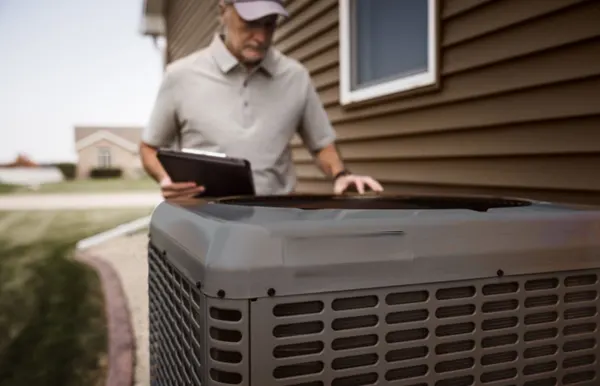
When you're unable to resolve the Carrier AC blowing warm air problem on your own, schedule air conditioning repair service online or call us at 1-800-469-4663 to set up an AC repair appointment.

Book online in less than a minute.

Apply your diagnostic fee to the costs of repair.

Save up to $150 on your repair if you enroll in a home warranty.
Discover what the Seasonal Energy Efficiency Ratio (SEER) is and why it's crucial for assessing air conditioner efficiency.

Learn how an air filter works in your HVAC system and how to choose the right filter.

Improve indoor air quality and protect your family's health with HVAC maintenance, air purifiers, and natural solutions like plants and proper ventilation.

Wondering what it costs to replace an air conditioner in 2026? This guide explains average replacement pricing, SEER2 efficiency costs, and how to decide whether to repair or replace your AC system.
The 608 Certification, mandated by the Environmental Protection Agency (EPA), is required for HVAC technicians to legally handle refrigerants. It ensures technicians understand refrigerant types, environmental impact, and proper handling techniques.
A compressor is a mechanical device that increases the pressure of a gas by reducing its volume, essential in various systems including refrigerators, air conditioners, and HVAC units for cooling and refrigeration processes.
A condenser is a component of HVAC and refrigeration systems, responsible for releasing absorbed heat from the refrigerant into the outside air or a water line, thus facilitating the cooling process.
A capacitor in an AC unit is an electrical component that stores and releases electrical energy to help start the motor and stabilize the voltage during operation.