 Appointment Lookup
 213-596-2538

Discover effective stain removal hacks tested with common household ingredients to tackle grease, grass, and ink stains.

Finding an awful sewage smell coming from your washer is certainly troubling. You may wonder whether you’ll ever be able to trust your washer to get clothes clean when it smells like that.
The good news is that you can fix the problem fairly easily and prevent it from recurring with some basic cleaning and maintenance tips.
KEY TAKEAWAYS
Here are the common causes of sewage smell coming from the washer.
Front-load washers are notorious for emitting awful smells because they often lack the ventilation needed to prevent foul smelling bacteria, mold and mildew from forming in the bottom of the washer tub and the drain system.
Top-load washers can develop smells but they typically aren’t as severe as the smells that emanate from front-loaders. Smells from top-loaders are often caused by detergent residue that builds up in the tub and eventually starts smelling like sewage.

Clogs of lint, debris and residue can cause the drain hose to start smelling.
Pull the drain hose out of the stand pipe and check the end of the hose for a buildup of lint, residue and debris. Clear out the drain hose to prevent the smell.

Sometimes, the sewer smell isn’t actually coming from your washer. Plumbing problems with the house drain for the washer such as a dry p-trap can cause a sewer smell to come from the stand-pipe behind your washer.
The p-trap is the u-shaped section of pipe below the stand pipe that traps a small amount of drain water to create a seal that prevents sewer smells from wafting up through the top of the washer standpipe. You’ll see the same device under your kitchen and bathroom sinks.
If you don’t use the washer for a month or two, the water in that p-trap can evaporate and allow the sewer smell to enter your laundry room.
If you smell a sewer smell coming from the washer standpipe, simply pour a bucket of water down the standpipe to restore the p-trap seal and eliminate the smell.
Continue to pour water down the standpipe every few weeks if you go through extended periods of not using your washer to prevent the sewer smell from recurring.

Your home's drain pipes have a vent pipe that prevents sewer gases from entering the home. If the vent pipe for your washer’s drain becomes clogged, it could cause the gases from the sewer lines to back into the laundry room.
If you notice the sewage smell coming from the walls around the vent pipe, contact a plumber to resolve the issue.

Sewage or rotten egg smells might also be caused by a buildup of hair, lint, debris and soap scum clogging the house drain line or stand pipe for your washer.
Remove the washer drain hose from the drain pipe in the wall, and then run a drain snake through the pipe to clear out any blockages.
Pour water through the stand pipe to clear out residue and make sure the drain works properly.
Follow these expert tips to get rid of sewage smell in your front-load washer.
Most of the time, sewage smell coming from your front-load washer is emanating from the drain pump filter. Cleaning that filter will typically eliminate the sewage smell.
For many front-load washers, you’ll see a cover at the bottom of the front panel that you can open to clean the drain pump filter as shown in the image below:
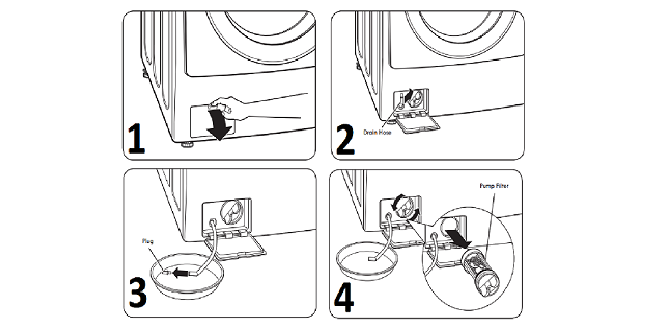
On some washers, you’ll need to remove the bottom front service panel to access the drain pump filter as shown in this popular YouTube DIY video:
Clean the drain pump filter thoroughly. Use a brush if necessary. If you find mold and mildew in the filter and housing, don some protective gloves and clean those parts with a solution of bleach and water.
If you’re unable to clean the drain pump filter yourself, schedule washer maintenance service and we’ll send a Sears Home Services technician to your home to do it for you.
After cleaning the drain pump filter, run a cleaning cycle in your front-load washer.
Most front-load washer have a specific cleaning cycle on the control panel for cleaning the washer. Follow the directions in the owner’s manual to start that cycle.
To help clean the washer thoroughly, use a washer cleaner such as Affresh or Washer Magic to help eliminate mold, mildew and residue from the washer tub and drain system.
If your front-load washer doesn’t have a cleaning cycle, run a Bulky cycle or Normal Wash cycle using hot water.
If you found mold and mildew in the drain pump filter, run a second cleaning cycle with a cup of liquid chlorine bleach added to the tub. This will clean and help deodorize the washer. Run one more cycle after that to completely rinse bleach out of the washer.
These steps should help deodorize a front load washer. To prevent the smell from returning:
Foul smells from your top-load washer are typically much less extreme than the nightmarish smell described above in a front-load washer.
You can typically eliminate odors from a top-load washer by running a cleaning cycle using a washer cleaner such as Affresh or Washer Magic.
The washer cleaner will help remove soap scum and deposit from the washer tub to eliminate foul smells.
Repeat the washer cleaning monthly and keep an eye out for drain hose and house drain clogs. Keeping the drain system and tub clean should eliminate and prevent smells in your top-load washer.
Having your top-load washer professionally maintained yearly will keep it running smoothly and smelling fresh. Annual preventive maintenance will also help your washer last longer.
Keeping your washer clean and well-maintained will restore confidence in your machine that it’s getting your clothes clean and fresh-smelling during each cycle.
Increase the lifespan and performance of your washer with our comprehensive maintenance service, ensuring reliable laundry care and continued peace of mind.
Loading scheduler options...
Discover effective stain removal hacks tested with common household ingredients to tackle grease, grass, and ink stains.

Learn how to make any washer an energy efficient washer, and save money on your energy bills by using it the right way.

Discover simple solutions to eliminate detergent residue and ensure your laundry comes out clean and residue-free from your top-load washer.

Unpleasant odors in the laundry room can disrupt the tranquility of your home, signaling underlying issues that demand attention.
The drum is the core part of the washer that holds your laundry and enables the cleaning process through rotation, agitation, and rinsing.
Hard water is water that contains high levels of dissolved minerals, particularly calcium and magnesium. It contrasts with soft water, which has lower concentrations of these minerals.
A washing machine pedestal is a platform that raises the washer off the ground, providing easier access to the appliances and often includes additional storage space such as drawers.
A washer tub is the interior part of a washing machine where clothes are placed for washing, typically made of stainless steel, plastic, or porcelain-coated metal, designed to hold water and withstand the agitation or spinning during the wash cycle.
The most common reasons your LG washer is leaking from bottom are a clogged water valve assembly, broken motor or a cracked drain hose.
The most common reasons your GE washer won't start cycle are a malfunctioning electronic control board, jammed door lock assembly or a faulty user interface.
The most common reasons your Whirlpool washer is not rinsing are a faulty lid switch, a bad water-level pressure switch, or a defective timer.
The most common reasons your GE washer is not filling are a clogged water valve assembly, malfunctioning electronic control board or a bad water level pressure switch.
The most common reasons your Samsung washer top load is not filling with water are a clogged water valve, a malfunctioning PCB, or a cracked hose.
The most common reasons your Samsung washer is noisy are a damaged suspension rod, malfunctioning electronic control board or a broken motor.