 Appointment Lookup
 213-596-2538

Learn how a pressure sensor works in home appliances and HVAC systems.

Solenoid valves play a crucial role in a wide range of home appliance. Whether used in a washing machine or a dryer, solenoid valves offer precise control over the flow of liquids and gases, making them essential for automation and fluid management.
But how do these small, efficient devices work? Let’s dive into the mechanics, operation, and common applications of solenoid valves to uncover their significance and versatility.
KEY TAKEAWAYS
A solenoid valve is an electromechanically operated valve that controls the flow of liquid or gas through a system.
The valve is operated by an electric coil called a solenoid, which, when energized, creates a magnetic field. This magnetic field moves a plunger or armature inside the valve, opening or closing the passage for fluid or gas flow.
Solenoid valves are often preferred in automated systems for their reliability, quick response, and precise control.
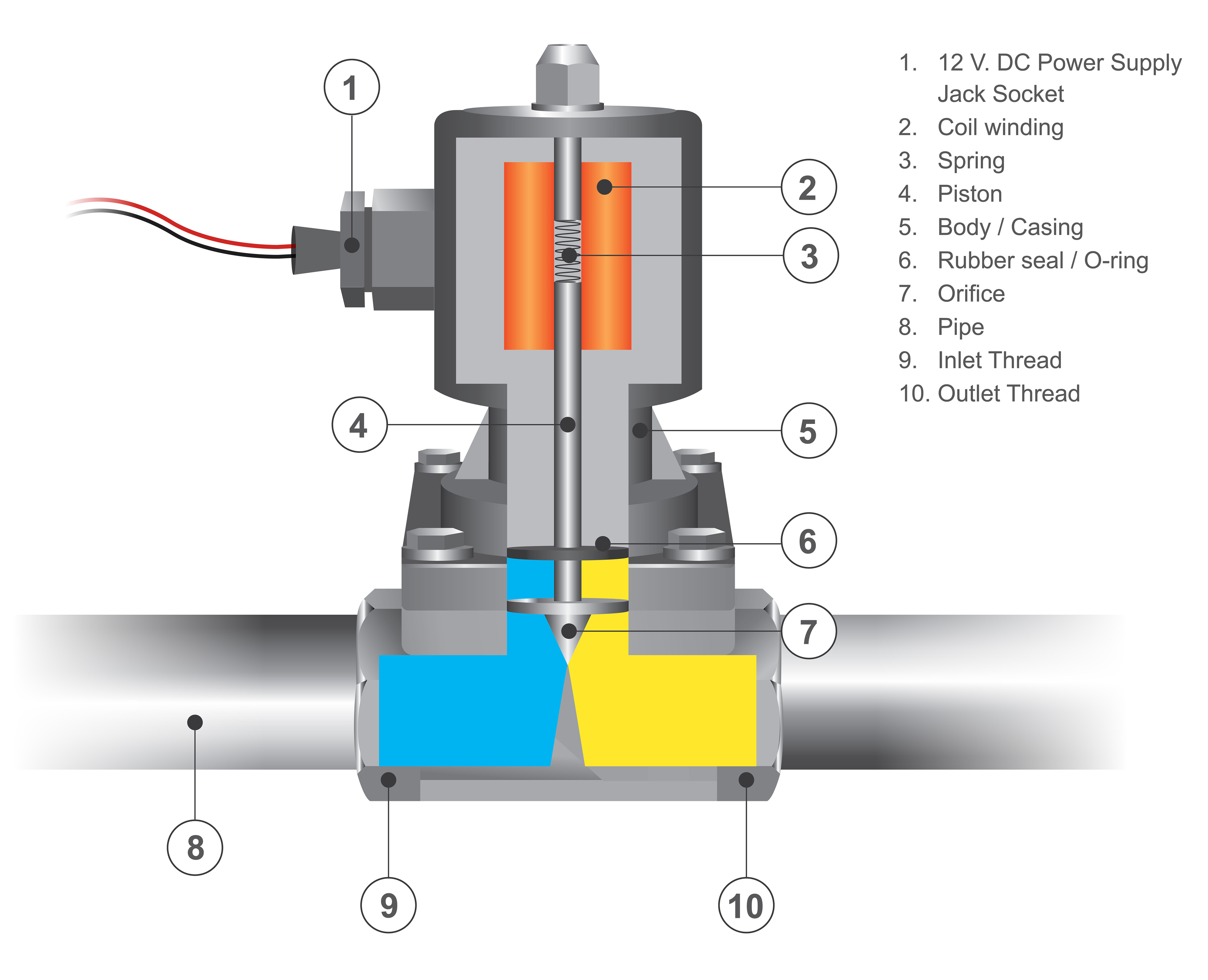
Understanding the working of a solenoid valve requires a closer look at its key components:
The operation of a solenoid valve can be understood in two phases: energized (when electric current is applied) and de-energized (when electric current is removed).
When the solenoid coil is energized, it creates a magnetic field that pulls the plunger or armature away from the valve seat. This movement opens the valve, allowing the fluid or gas to flow through the inlet and out through the outlet.
When the electric current is cut off, the magnetic field collapses, and the spring pushes the plunger back to its original position, which closes the valve. In this state, the fluid or gas flow is stopped, or redirected, depending on the specific valve design.
Thanks to their versatility and reliability, solenoid valves are found in an extensive variety of appliance applications. Here are some examples of appliances that use solenoid valves and how to troubleshoot common problems.
Washers use at least 2 solenoid water valves (hot & cold) to fill the washer tub. Many front-load washers and some top-load models have additional water valves for dispensing detergent and other cleaning media such as bleach and fabric softener.
The electronic control or timer provides power to open the valves and fill the washer as well as dispense additives at various times during the cycle.
In some washers – mainly top-load washers, the water level pressure switch shuts off current to the solenoid fill valves to stop the filling process and advance the wash or rinse cycle.
If you have a top-load washer that won’t fill, follow the DIY troubleshooting steps in this video to find and fix the problem:
If you’re unable to find and fix the cause of a fill problem in your washing machine, schedule washer repair service and we’ll send a Sears Home Services technician to your home to fix the fill problem for you.
A dishwasher uses a single solenoid water valve to fill its tub with water. The electronic control board or timer on a dishwasher controls electronic current going to the fill valve.
Most dishwashers use an overfill float switch to shut off electric current going to the fill valve to prevent overfilling the tub.
While a failed solenoid valve can prevent a dishwasher from filling, you’ll need to properly diagnose the cause of a dishwasher fill failure because other components could be causing the problem. Here’s a DIY troubleshooting video that shows how to fix a fill problem in the most common types of dishwashers:
If you’re unable to find and fix the cause of a dishwasher fail failure, schedule dishwasher repair service to have a Sears Home Services tech resolve the issue for you.
Many refrigerators have ice makers and water dispensers that use solenoid water valves to control water flow to these components.
The control system for these valves vary. The ice maker module, water dispenser switch and/or electronic control boards control the activation of water valves to supply water to the ice maker and water dispenser.
When your refrigerator isn’t getting water, follow the tips in our How to diagnose a faulty refrigerator water inlet valve article to find and fix the cause of the problem. As always, if you’re unable to resolve a water supply problem with your fridge on your own, schedule service to have a technician fix the issue.
Gas dryers use solenoid gas valves connected in a safety circuit with a flame sensor to supply the burner with natural gas or Propane gas. Failed solenoid valve coils are a leading cause of heating problems in gas dryers.
Here’s a DIY troubleshooting video that explains how solenoid gas valves operate in a clothes dryer and how to fix a heating problem in that appliance:
Replace the solenoid gas valve coils if they’re too weak to open the gas valves to heat the dryer.
If you’re unable to find and fix a heating problem in your dryer on your own, schedule dryer repair service and we’ll resolve the heating issue for you.
To prevent the appliance failures caused by failed solenoid valves and other issues like the ones outlined above, properly maintain your appliances as described in their owner’s manuals.
Additionally, schedule professional appliance maintenance yearly to have a technician thoroughly clean and check all of your home appliances. The tech will test the operation of the solenoid valves as well as all of the other controls and components in your appliances.
With Sears Home Services, you can schedule professional cleaning and maintenance service for all of your home appliances in one visit to keep them all in top shape and lasting longer.
During maintenance service, our technicians can spot and resolve problems with solenoid valves or other components that could result in unexpected failures during the year.
At Sears Home Services, we have experienced techs who are experts at diagnosing and fixing all types of solenoid valve problems as well as all other appliance failures.
Trust our experienced technicians to handle your washer and dryer repairs, regardless of the problem.
Loading scheduler options...
Learn how a pressure sensor works in home appliances and HVAC systems.

Discover the top 5 surprises new homeowners face, from home maintenance and repairs to energy efficiency and security tips. Learn how to navigate these challenges with expert advice and support from Sears Home Services.

Learn how to read and use a wiring diagram for DIY appliance repair on searshomeservices.com

As a homeowner, you understand the importance of well-functioning appliances.
ENERGY STAR appliances are energy-efficient products that meet the strict energy efficiency specifications set by the U.S. Environmental Protection Agency or the U.S. Department of Energy. These appliances are designed to use less energy and water, leading to cost savings and a reduced environmental impact.
Wattage is the measure of electrical power expressed in watts (W), indicating the rate at which a device consumes energy.
A washer screw is a fastening device that combines a screw and a washer, designed to distribute the load of a screwed fastening more evenly and to prevent the screw from loosening under vibration.
A voltage meter, commonly referred to as a voltmeter, is an instrument used for measuring the electrical potential difference, or voltage, between two points in an electrical or electronic circuit.
When your Payne central air conditioner won’t turn on or isn’t cooling, check for power problems, a failed capacitor, or a clogged condensate drain. This guide covers quick, safe troubleshooting steps and explains when to call Sears Home Services for expert central AC repair.
When your ICP central air conditioner won’t turn on or isn’t cooling, check for power problems, a failed capacitor, or a clogged condensate drain. This guide covers quick, safe troubleshooting steps and explains when to call Sears Home Services for expert central AC repair.
When your Heil central air conditioner won’t turn on or isn’t cooling, check for power problems, a failed capacitor, or a clogged condensate drain. This guide covers quick, safe troubleshooting steps and explains when to call Sears Home Services for expert central AC repair.
When your Carrier central air conditioner won’t turn on or isn’t cooling, check for power problems, a failed capacitor, or a clogged condensate drain. This guide covers quick, safe troubleshooting steps and explains when to call Sears Home Services for expert central AC repair.
When your Comfortmaker central air conditioner won’t turn on or isn’t cooling, check for power problems, a failed capacitor, or a clogged condensate drain. This guide covers quick, safe troubleshooting steps and explains when to call Sears Home Services for expert central AC repair.
When your Ruud central air conditioner won’t turn on or isn’t cooling, check for power problems, a failed capacitor, or a clogged condensate drain. This guide covers quick, safe troubleshooting steps and explains when to call Sears Home Services for expert central AC repair.