 Appointment Lookup
 213-596-2538

Learn how fabric softener works to make your clothes soft and leave it smelling fresh.

If you live in a small apartment, RV, or dorm, a portable washer and dryer can be a game-changer. These compact appliances offer the convenience of in-home laundry without the need for built-in hookups or dedicated laundry rooms.
But how exactly do they work, and how do they differ from traditional washers and dryers? Let’s break it down, along with expert maintenance tips to keep your units running smoothly.
KEY TAKEAWAYS
Portable washers operate similarly to traditional washing machines but are designed for mobility and space-saving. Here’s how they work:
Unlike built-in washers that connect to dedicated hot and cold water lines, portable washers use a faucet adapter to connect directly to a sink. This makes them ideal for spaces without traditional laundry appliance hookups.
These machines feature a drum where clothes are washed and spun. You add detergent, load your clothes, and select the desired cycle just like you would with a full-size washer.
The capacity of a portable washer is typically much less than that of a full-sized washer to facilitate mobility.
Portable washers use a drainage hose that empties into a sink or bathtub. Gravity or a small pump helps guide the water out after each cycle.
Portable dryers are equally straightforward but have some distinct differences compared to built-in models:
Many portable dryers are ventless, using a condensation drying system that collects moisture in a reservoir. Others have a venting system that can be directed out of a window to the outside of your home.
Portable dryers typically use a 120-volt plug, similar to portable washers. This lower power requirement creates less heat and lengthens drying times.
The capacity of portable dryers is much less than conventional dryers.
Clothes are tumbled in a drum while either hot air evaporates moisture (vented) or heat and condensation remove water from the fabric (ventless).
While portable washers and dryers are smaller, lighter, moveable and more convenient to hook up practically anywhere in your home, they suffer from drawbacks of lower laundry capacity, diminished washing performance and longer dry times.
Portable washers and dryers are for use in situations where you don’t have space and hook-ups available for full-sized laundry appliances.
Keeping your portable washer and dryer in top condition ensures longevity and optimal performance. Here are some expert washer maintenance tips.
Follow these steps to keep your portable washer in top shape:
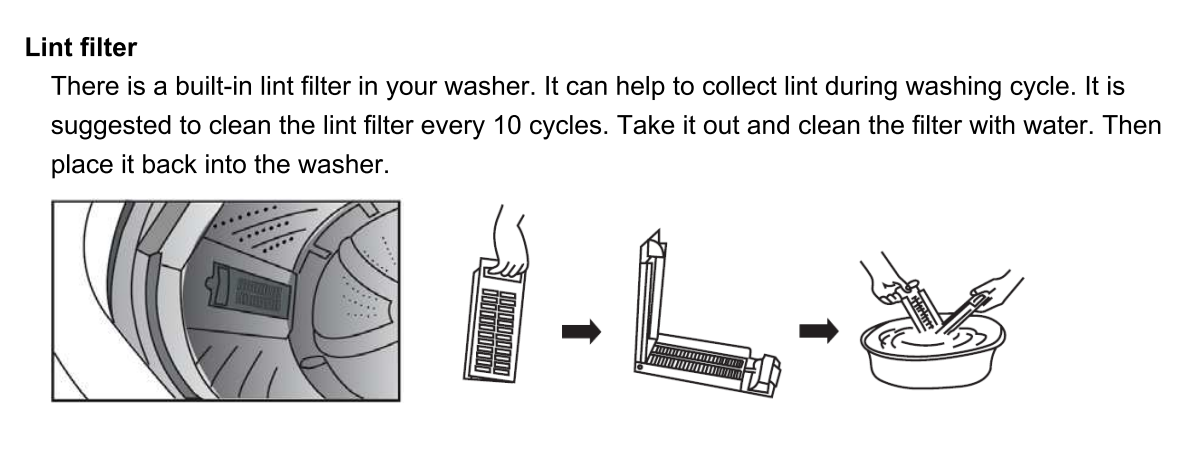
Just like a traditional washer, portable models have lint filters that need cleaning after every few uses.
Follow the directions in the owner’s manual to clean the lint filter in your portable washer.
Here’s an example showing how to clean the lint filter in a common portable washer:
Cleaning the drain pump filter helps prevent the drain hose from clogging and also filters out debris that can clog your sink or bathtub drain.
Follow the guidelines in your owner’s manual for cleaning the drain pump filter.
Here’s an example of how to clean the drain pump filter in a common type of portable washer:

Hard water can leave mineral deposits. Use a washing machine cleaner or a mixture of vinegar and baking soda monthly to descale the drum.
Here’s a brief video that shows how to use Affresh washer cleaner:
Check for kinks or leaks in the inlet and drain hoses to avoid water damage.
Replace any cracked or damaged hoses immediately.
Follow these expert tips to make sure that your portable dryer stays in top shape:
By understanding how portable washers and dryers work and following proper maintenance routines, you can enjoy hassle-free laundry days, no matter where you live.
Regular laundry appliance maintenance can help prevent costly breakdowns, reduce energy costs and extend the life of your washer and dryer. We’ll perform a 31-point inspection on your washer and dryer.
Loading scheduler options...
Learn how fabric softener works to make your clothes soft and leave it smelling fresh.

Learn how a condensing washer dryer combo works.
Check out these common myths learn the truth about doing laundry.

Discover the meaning behind laundry label symbols with our helpful guide - laundry label symbols explained!
ENERGY STAR appliances are energy-efficient products that meet the strict energy efficiency specifications set by the U.S. Environmental Protection Agency or the U.S. Department of Energy. These appliances are designed to use less energy and water, leading to cost savings and a reduced environmental impact.
Wattage is the measure of electrical power expressed in watts (W), indicating the rate at which a device consumes energy.
A washer screw is a fastening device that combines a screw and a washer, designed to distribute the load of a screwed fastening more evenly and to prevent the screw from loosening under vibration.
A voltage meter, commonly referred to as a voltmeter, is an instrument used for measuring the electrical potential difference, or voltage, between two points in an electrical or electronic circuit.
When your Payne central air conditioner won’t turn on or isn’t cooling, check for power problems, a failed capacitor, or a clogged condensate drain. This guide covers quick, safe troubleshooting steps and explains when to call Sears Home Services for expert central AC repair.
When your ICP central air conditioner won’t turn on or isn’t cooling, check for power problems, a failed capacitor, or a clogged condensate drain. This guide covers quick, safe troubleshooting steps and explains when to call Sears Home Services for expert central AC repair.
When your Heil central air conditioner won’t turn on or isn’t cooling, check for power problems, a failed capacitor, or a clogged condensate drain. This guide covers quick, safe troubleshooting steps and explains when to call Sears Home Services for expert central AC repair.
When your Carrier central air conditioner won’t turn on or isn’t cooling, check for power problems, a failed capacitor, or a clogged condensate drain. This guide covers quick, safe troubleshooting steps and explains when to call Sears Home Services for expert central AC repair.
When your Comfortmaker central air conditioner won’t turn on or isn’t cooling, check for power problems, a failed capacitor, or a clogged condensate drain. This guide covers quick, safe troubleshooting steps and explains when to call Sears Home Services for expert central AC repair.
When your Ruud central air conditioner won’t turn on or isn’t cooling, check for power problems, a failed capacitor, or a clogged condensate drain. This guide covers quick, safe troubleshooting steps and explains when to call Sears Home Services for expert central AC repair.