 Appointment Lookup
 213-596-2538

Discover how thermostats work to control your home's comfort and energy use. Learn about types, programming tips, and maintenance for a more efficient home.
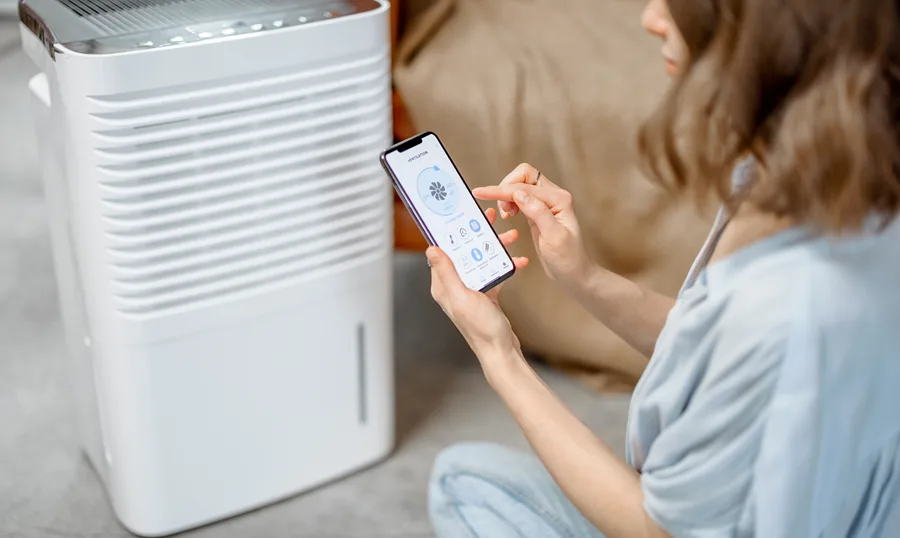
Tired of your home feeling like a tropical rainforest? A dehumidifier can help by reducing indoor humidity, making your space more comfortable and protecting your belongings. High humidity can lead to issues like mold, musty odors, and even damage to furniture and electronics.
Dehumidifiers work by drawing in humid air, cooling it to condense the moisture into droplets, and collecting it in a reservoir or draining it away. This leaves the air drier and more comfortable, helping create a healthier environment.
While air conditioners remove some moisture as they cool, dehumidifiers are specifically designed to tackle high humidity levels, maintaining a balanced indoor atmosphere. In larger homes, whole-house dehumidifiers connect with HVAC systems to regulate humidity throughout the entire space.
KEY TAKEAWAYS
So, what the heck is a dehumidifier, anyway? Put simply, a dehumidifier is an appliance that controls indoor humidity levels, making your home feel fresher and improving air quality. It’s especially handy in areas with high humidity or during those wet seasons when moisture levels tend to rise.
A dehumidifier helps maintain ideal indoor humidity, usually between 30% and 50%, which can prevent a range of common household issues:
Dehumidifiers work by pulling in humid air and cooling it over a cold coil (evaporator). This process condenses moisture from the air into water droplets, which are collected in a reservoir or drained away. Here’s how the process works:
Dehumidifiers come in different sizes to suit various room sizes and moisture needs. Many models also have helpful features:

Using a dehumidifier goes beyond just making your home feel less sticky. By reducing humidity levels, a dehumidifier contributes to a healthier and more comfortable indoor environment.
Lowering humidity with a dehumidifier can significantly improve indoor air quality and help protect your home. Here’s how it makes a difference:
While air conditioners remove some moisture as they cool, dehumidifiers focus specifically on reducing excess humidity. Here’s a quick comparison:
In high-humidity areas, using a dehumidifier alongside an air conditioner helps your cooling system operate more efficiently. Lower humidity means the air conditioner doesn’t have to work as hard to cool your home, which may also help save on energy costs.

Finding the best dehumidifier depends on your home’s size, humidity levels, and specific needs. The two main types are portable dehumidifiers and whole-house units, each with unique benefits.
Portable dehumidifiers are compact and easy to move from room to room, making them ideal for small to medium-sized areas like bedrooms, basements, and living rooms. These units allow targeted moisture control where it’s needed most, helping improve comfort in specific spaces. Portable dehumidifiers tend to be budget-friendly and work best in confined areas rather than large spaces.
For homes with widespread humidity concerns, whole-house dehumidifiers provide a powerful solution. Connected directly to the HVAC system, they reduce moisture levels across the entire home. Whole-house dehumidifiers operate through existing ductwork, capturing humidity from each room and expelling it outside, leaving consistently comfortable air in every corner.
Whole-house units work in harmony with your heating and cooling system, and regular upkeep is important to maintain performance. For instance, yearly HVAC maintenance will keep your HVAC system in top shape, supporting the efficiency of your whole-house dehumidifier. If issues arise with your HVAC system, promptly schedule HVAC repair to address any impact on your home's comfort level.
When deciding between a portable and a whole-house dehumidifier, think about the following:
In short, the choice between a portable and a whole-house dehumidifier depends on your home’s needs, budget, and humidity levels. Addressing high humidity can help protect your belongings, improve indoor air quality, and create a more comfortable living environment.
HVAC checkups from Sears Home Services help keep your heating and cooling system running at its best. Prevent costly repairs and can make your HVAC system more energy efficient with routine maintenance.
Loading scheduler options...
Discover how thermostats work to control your home's comfort and energy use. Learn about types, programming tips, and maintenance for a more efficient home.

Learn how HEPA filters work and how they can help improve your home’s indoor air quality.

Learn how a heat pump works to efficiently heat and cool your home while saving energy and money year-round. Discover their benefits, types, and maintenance tips.

Discover how the condenser works in a central air conditioner system and how to maintain it.
The 608 Certification, mandated by the Environmental Protection Agency (EPA), is required for HVAC technicians to legally handle refrigerants. It ensures technicians understand refrigerant types, environmental impact, and proper handling techniques.
A compressor is a mechanical device that increases the pressure of a gas by reducing its volume, essential in various systems including refrigerators, air conditioners, and HVAC units for cooling and refrigeration processes.
A condenser is a component of HVAC and refrigeration systems, responsible for releasing absorbed heat from the refrigerant into the outside air or a water line, thus facilitating the cooling process.
A capacitor in an AC unit is an electrical component that stores and releases electrical energy to help start the motor and stabilize the voltage during operation.
When your Payne central air conditioner won’t turn on or isn’t cooling, check for power problems, a failed capacitor, or a clogged condensate drain. This guide covers quick, safe troubleshooting steps and explains when to call Sears Home Services for expert central AC repair.
When your ICP central air conditioner won’t turn on or isn’t cooling, check for power problems, a failed capacitor, or a clogged condensate drain. This guide covers quick, safe troubleshooting steps and explains when to call Sears Home Services for expert central AC repair.
When your Heil central air conditioner won’t turn on or isn’t cooling, check for power problems, a failed capacitor, or a clogged condensate drain. This guide covers quick, safe troubleshooting steps and explains when to call Sears Home Services for expert central AC repair.
When your Carrier central air conditioner won’t turn on or isn’t cooling, check for power problems, a failed capacitor, or a clogged condensate drain. This guide covers quick, safe troubleshooting steps and explains when to call Sears Home Services for expert central AC repair.
When your Comfortmaker central air conditioner won’t turn on or isn’t cooling, check for power problems, a failed capacitor, or a clogged condensate drain. This guide covers quick, safe troubleshooting steps and explains when to call Sears Home Services for expert central AC repair.
When your Ruud central air conditioner won’t turn on or isn’t cooling, check for power problems, a failed capacitor, or a clogged condensate drain. This guide covers quick, safe troubleshooting steps and explains when to call Sears Home Services for expert central AC repair.